Australia
What Is in Black Seed Oil? Thymoquinone and Other Compounds Explained
Black seed oil combines fatty acids with active compounds such as thymoquinone. Here is a clear guide to what is inside and how labels describe it.
Key takeaways
- Most of black seed oil is unsaturated fatty acids, mainly linoleic acid.
- Thymoquinone is the most studied active compound.
- TQ content varies naturally between oils and growing regions.
Black seed oil has a rich, peppery character that comes from a blend of fatty acids and aromatic compounds. Understanding them helps you read labels with confidence.
The fatty acid base
Reviews report that Nigella sativa oil is mostly unsaturated fat, with linoleic acid as the main fatty acid, followed by oleic acid.[1]
Thymoquinone: the star compound
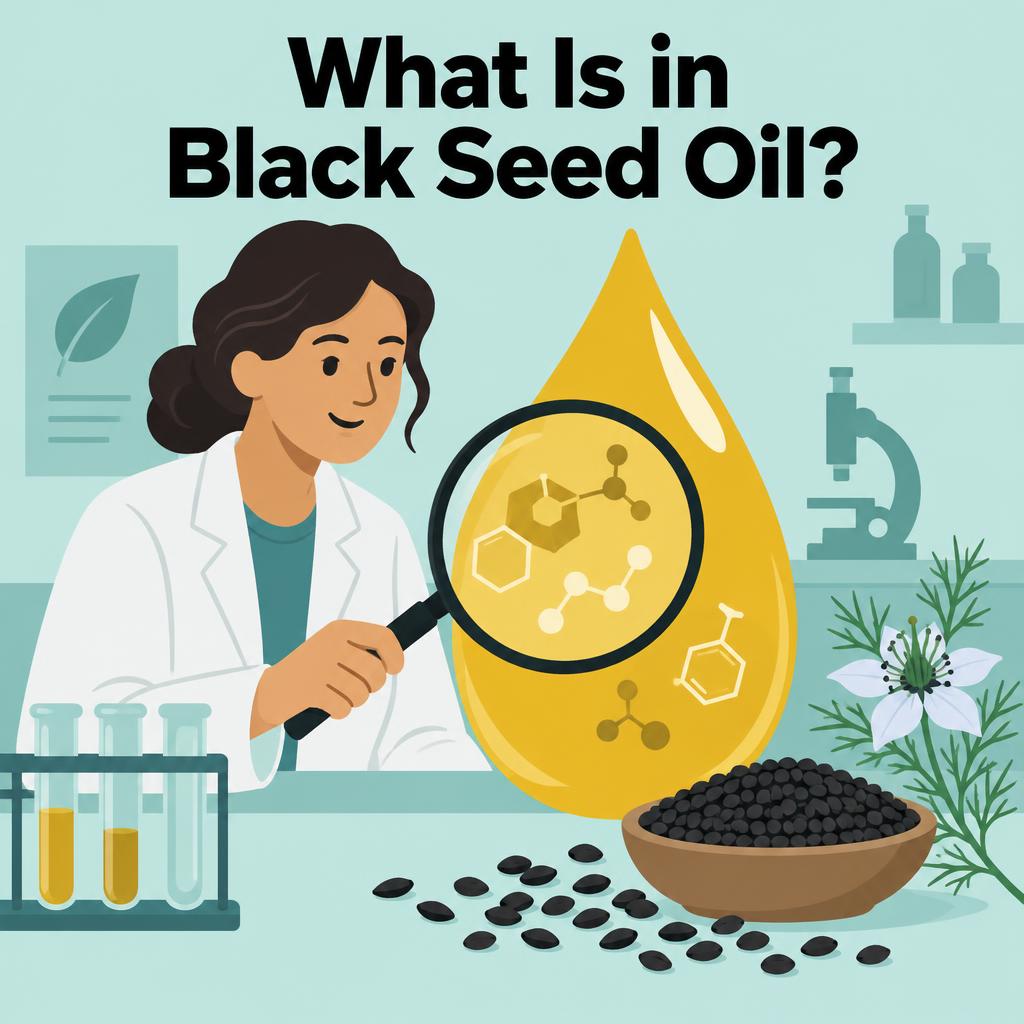
Thymoquinone, often shortened to TQ, is the most researched active compound in black seed oil. It has been studied for antioxidant and anti-inflammatory activity in laboratory and animal research.[1]
Other compounds
- Thymohydroquinone and dithymoquinone, related to TQ.
- p-Cymene and other aromatic terpenes.
- Tocopherols (vitamin E forms) and sterols.
- Small amounts of alkaloids and saponins.
Why levels vary
Seed origin, harvest, storage and pressing method all change the amount of TQ in an oil. That is why labels may describe TQ as naturally occurring rather than added.
From compounds to health outcomes
A 2023 overview of meta-analyses found encouraging results for several health measures, with low certainty for many.[2] A compound's activity in the lab is a starting point, not a guarantee of results in people.
Antidote Supplements
Antidote Supplements offers Ethiopian Black Seed Oil as 50 mL liquid drops. The combination softgels state up to 4.64% naturally occurring thymoquinone. Antidote Supplements confirms delivery to Australia.
The bottom line
Black seed oil is mainly unsaturated fatty acids with thymoquinone as its best-known active compound. TQ varies naturally between oils, and research on these compounds continues to grow.
Medical reviewer
Dr Hemal Patel
General Practitioner
Read this next
Nigella sativa
Black Seed Oil (Nigella Sativa): The Science Behind the Seed, Australian Guide
Understand how laboratory studies, human trials and systematic reviews contribute to the evidence for Nigella sativa.
Black Seed Oil
Cold-Pressed Black Seed Oil: Why the Extraction Method Matters in Australia
Understand mechanical pressing, heat and processing claims, plus the batch information that matters more than a cold-pressed label alone.
Black Seed Oil
Is Black Seed Oil Bad for Your Liver? An Australian Evidence Guide
What studies report about Nigella sativa and liver measures, and who should check with a doctor before using black seed oil.
Black Seed Oil
Is Black Seed Oil Good for Testosterone? What Australian Men Should Know
Animal studies and a small fertility trial have sparked interest, but testosterone claims need careful reading. Here is the evidence.
Black Seed Oil
Does Black Seed Oil Kill Parasites? What the Research Says in Australia
Traditional use and a few early studies have fuelled interest in Nigella sativa for parasites. Here is what the evidence covers and when to see a GP.
Black Seed Oil
Black Seed Oil for Male Fertility: How It's Used and What Studies Show
A placebo-controlled trial reported improved semen measures with black seed oil. Learn what was studied and how it fits with fertility care in Australia.
