Black Seeds vs. Black Seed Oil: What's the Difference?
Whole seeds, powder and oil all come from the same plant, but they're used differently and absorbed differently.
Key takeaways
- Whole seeds, powdered seeds and oil all come from Nigella sativa, but differ in concentration and use.
- Oil is more concentrated and easier to dose precisely.
- Whole or powdered seeds retain more fiber and are often used in cooking.
- Most clinical studies used either seed powder or oil — choose based on convenience.
Nigella sativa is sold in a few different forms, and it's easy to mix them up. Here's how whole black seeds, powdered black seeds and black seed oil actually differ.
Whole black seeds
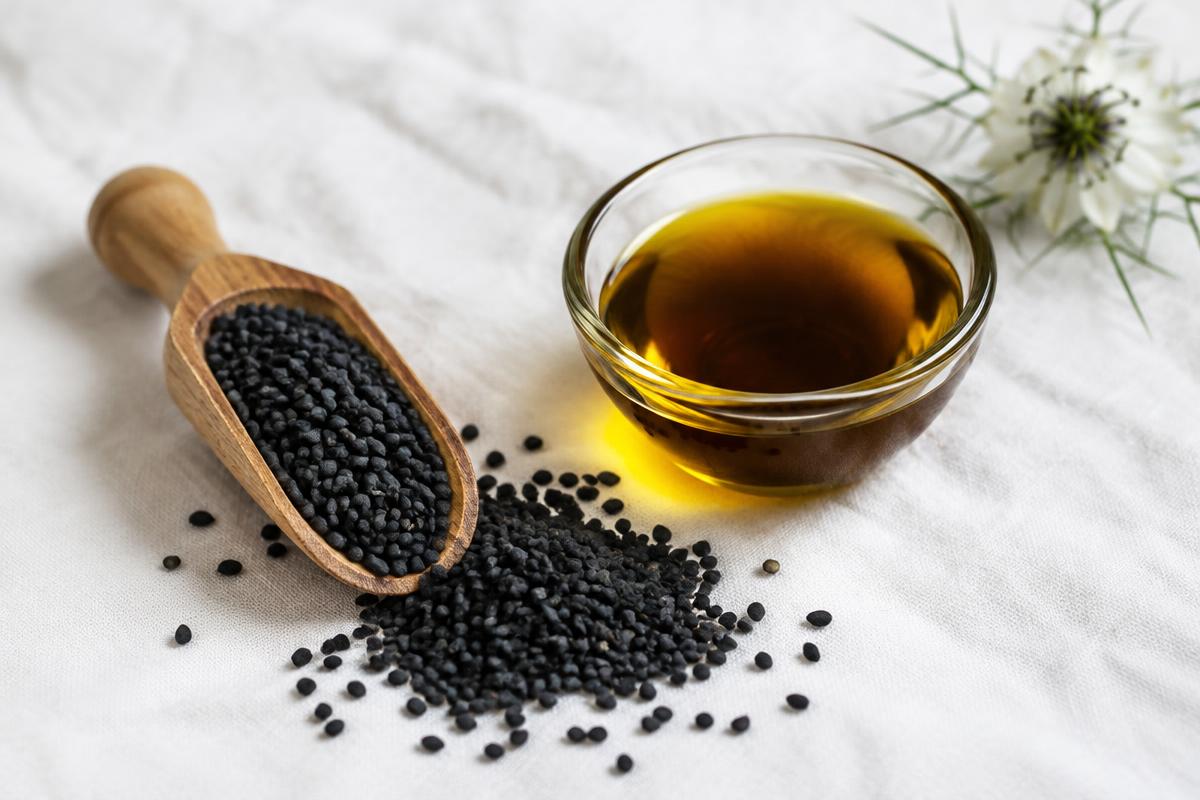
These are the dried, uncooked seeds — small, black and slightly bitter, often sprinkled on bread or used in South Asian and Middle Eastern cooking. They contain fiber along with the plant's oils.
Powdered black seeds
Ground whole seeds, sometimes used in capsules or mixed into food and drinks. Several clinical trials used seed powder rather than oil, particularly for blood sugar and cholesterol research.[1]
Black seed oil
Oil is extracted (usually cold-pressed) from the seeds, concentrating the fat-soluble compounds, including thymoquinone. It's easier to take in a precise dose — by the spoonful, in capsules, or applied to skin — and is the most common form sold as a general supplement.
Comparing the forms
| Form | Best for | Notes |
|---|---|---|
| Whole seeds | Cooking, baking | Mild effect, high fiber |
| Powder/capsules | Precise oral dosing | Used in several clinical trials |
| Oil | Daily supplement, topical use | Most concentrated, most common |
Which should you choose?
For general supplement use, oil is the most practical and widely studied form. If you prefer food-based approaches, whole or ground seeds work well stirred into yogurt, honey or bread dough.
When to see a doctor
Black seed oil and oregano oil are not a substitute for diagnosis or prescribed treatment. See a healthcare professional if symptoms are severe, getting worse or not improving.
Frequently asked questions
Is black seed oil stronger than whole seeds?
Gram for gram, the oil concentrates certain fat-soluble compounds, but whole seeds retain fiber and other nutrients the oil doesn't.
Can I grind my own black seed oil from seeds?
No — oil extraction requires pressing equipment. You can grind seeds into a powder at home, but that's not the same as oil.
The bottom line
Whole seeds, powder and oil all come from the same plant but suit different uses. Oil is the most concentrated and convenient option for most people using it as a daily supplement.
Read this next
Black Seed Oil
Black Seed vs Black Cumin vs Nigella: Are They the Same?
One plant, many names — and two that are often confused.
Dosage & Timing
How Much Black Seed Oil to Take Daily
Doses used in studies, translated into teaspoons and capsules.
Black Seed Oil
What Does Black Seed Oil Taste Like?
Bold, bitter and peppery — here's what to expect from black seed oil's taste, and how to skip it.
Black Seed Oil
Is Black Seed Oil a Binder? What the Term Actually Means
'Binder' is a wellness term, not a medical one. Here's where black seed oil and oregano oil fit.
Black Seed Oil
Black Seed Oil Benefits: What the Research Says
From skin health to blood sugar, here's what studies on black seed oil actually show.
Black Seed Oil
Black Seed Oil for Hair: Benefits and How to Use It
A simple scalp routine, realistic results and how it compares with hair vitamins.
Sources
- Ahmad A, Husain A, Mujeeb M, et al. A review on therapeutic potential of Nigella sativa: a miracle herb. Asian Pac J Trop Biomed. 2013;3(5):337-352.
- Daryabeygi-Khotbehsara R, Golzarand M, Ghaffari MP, Djafarian K. Nigella sativa improves glucose homeostasis and serum lipids in type 2 diabetes: a systematic review and meta-analysis. Complement Ther Med. 2017;35:6-13.