United Kingdom
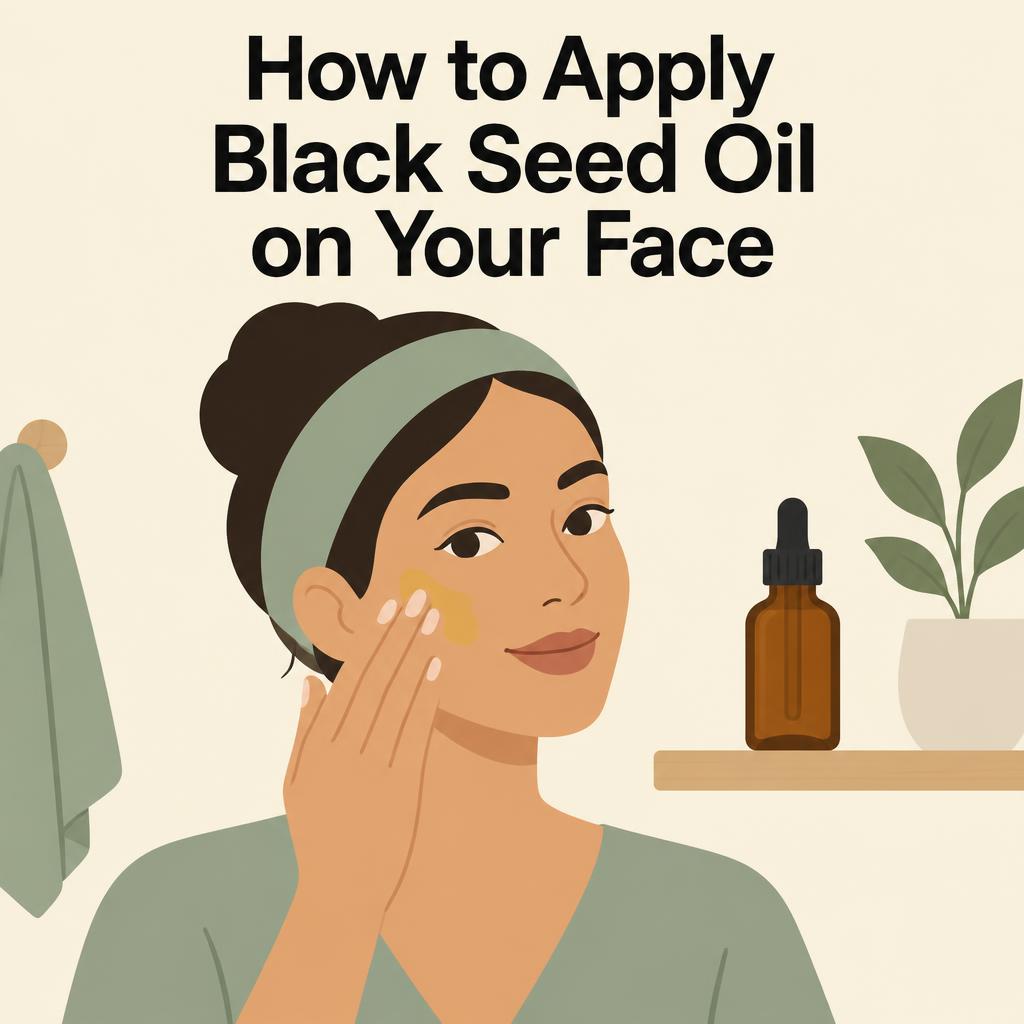
How to Apply Black Seed Oil on Your Face
How to use black seed oil on your face: how much, when, and the simple routine that works.
Key takeaways
- Two or three drops on cleansed skin is enough for the whole face.
- Apply after water-based products, as the last step, to seal in moisture.
- Patch test first if your skin is sensitive.
Black seed oil has become a favourite facial oil in the UK, and using it well is simple. Here is the routine that works.
Before you start
Patch test first: smooth a drop onto your inner arm and wait 24 hours. Black seed oil is well tolerated by most skin, but a patch test is good practice with any new oil.
The simple routine
- Cleanse your face as usual and pat dry.
- Apply any water-based products first, toner or serum.
- Warm two or three drops of black seed oil between your palms.
- Press gently over your face and neck; do not rub hard.
- Use it as the last step, to seal in moisture.
Morning or night
Night is the popular choice, since the oil is rich and can leave a slight sheen. If your skin is very dry, a single drop mixed into your morning moisturiser works well too.
How much is too much
More is not better with facial oils. Two or three drops cover the face; using more just sits on the surface. If your skin is oily or blemish-prone, start with one drop on dry areas only and see how your skin responds.
What to expect
The oil's fatty acids soften and nourish, and most people notice smoother, more comfortable skin within a couple of weeks of consistent use.[1][2]
Antidote Supplements
Antidote Supplements Ethiopian Black Seed Oil comes as 50 mL liquid drops; follow the label directions.
The bottom line
Apply two or three drops of black seed oil to cleansed skin as the last step of your routine, nightly. Patch test first and keep the amount small.
Medical reviewer
Dr Usha Venkataraman
MBBS, FRACGP
Read this next
How to Use
How to Use Black Seed Oil (Inside and Out)
Black seed oil works two ways: as a daily supplement and as a skin and hair oil. How to use it both ways.
Black Seed Oil
Black Seed Oil: Benefits, Uses and Side Effects (Complete Guide)
The complete UK guide to black seed oil: what it is, what the research shows, how to take it and who should check first.
Black Seed Oil
Black Seed Oil Benefits: 10 Reasons People Take It
From metabolic support to antioxidant intake, here are the ten most common reasons people take black seed oil every day.
Black Seed Oil
Black Cumin Seed Oil: A Complete Guide
Black cumin seed oil is black seed oil by another name. This guide covers what it is, the research and how to take it.
Black Seed Oil
Advantages of Black Seed Oil: Why It's Been Used for Centuries
Black seed oil has been used for over two thousand years. Here is why it has lasted, and what modern research adds.
How to Use
Black Seed Oil Capsules vs Liquid: Which Is Better?
Capsules or liquid drops? Here is how the two formats compare on taste, convenience, dose control and value.
Sources
- Ahmad A, et al. A review on therapeutic potential of Nigella sativa: A miracle herb. Asian Pacific Journal of Tropical Biomedicine. 2013;3(5):337-352.
- Khader M, Eckl PM. Thymoquinone: an emerging natural drug with a wide range of medical applications. Iranian Journal of Basic Medical Sciences. 2014;17(12):950-957.
- Li Z, et al. Nigella sativa and health outcomes: An overview of systematic reviews and meta-analyses. Frontiers in Nutrition. 2023;10:1107750.
