Egyptian vs. Ethiopian Black Seed Oil: How Do They Compare?
Black seed oil's origin is a common marketing point. Here's what actually varies by region, and what doesn't.
Key takeaways
- Nigella sativa is grown across Egypt, Ethiopia, Turkey, India and other regions, each with slightly different growing conditions.
- Research has found that thymoquinone content can vary between seed sources, but origin alone doesn't guarantee higher or lower quality.
- Processing method (cold-pressed vs. heat-extracted) affects potency at least as much as geographic origin.
- Third-party testing is the most reliable way to compare actual thymoquinone content between products, regardless of origin.
Where is black seed oil grown?
Nigella sativa is cultivated in many regions, with Egypt, Ethiopia, Turkey, Syria, India and Pakistan among the most commonly cited sources in the supplement industry. Egyptian black seed has a long traditional reputation, partly due to its historical use in ancient Egyptian medicine, while Ethiopian black seed (sometimes marketed separately from "true" Nigella sativa, alongside the related Nigella species) is also widely used.
Does origin affect thymoquinone content?
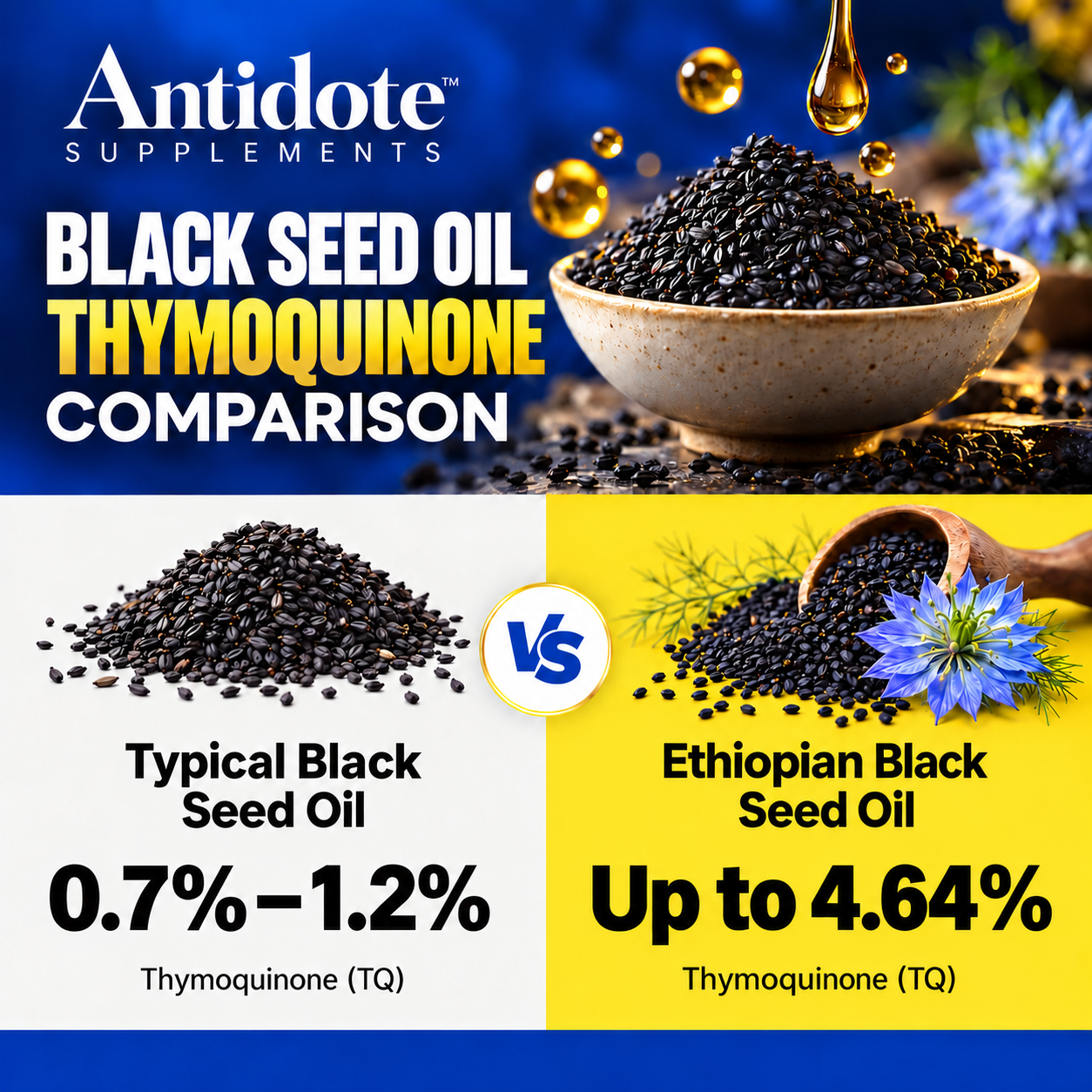
Some studies comparing Nigella sativa from different regions have found variation in thymoquinone and other active compound levels, likely influenced by soil, climate, harvest timing and seed variety.[1] However, origin alone isn't a reliable predictor — two batches from the same country can differ based on growing conditions and processing.
Egyptian vs. Ethiopian vs. Turkish: a side-by-side look
| Origin | Reputation | What to verify |
|---|---|---|
| Egyptian | Long traditional use; often marketed as premium | Ask for a COA confirming thymoquinone content |
| Ethiopian | Widely available, often more affordable | Confirm species (Nigella sativa) and testing |
| Turkish | Associated with high-quality Nigella sativa varieties in some research | Check extraction method and freshness |
What matters more than country of origin
- Extraction method — cold-pressed oils typically retain more active compounds than heat-processed ones.
- Freshness and storage — oxidation reduces potency over time regardless of origin.
- Third-party testing — the only way to actually confirm thymoquinone levels.
- Seed variety — some products use related Nigella species, which may differ from true Nigella sativa.
Is one origin "better" for a specific use?
There isn't strong clinical evidence that a specific country of origin produces better outcomes for any particular health use. Most human trials on black seed oil don't report or compare seed origin as a variable — they focus on dosage and duration instead.[2]
When to see a doctor
Black seed oil and oregano oil are not a substitute for diagnosis or prescribed treatment. See a healthcare professional if symptoms are severe, getting worse or not improving.
Frequently asked questions
Is Ethiopian black seed oil the same plant as Egyptian?
Usually, yes — both are typically Nigella sativa, though always check the botanical name on the label since related Nigella species exist and are sometimes substituted.
Which origin has the highest thymoquinone content?
Research findings vary by study and batch; there's no consistent, universally agreed "highest" origin. Always check product-specific lab testing.
Does origin affect taste?
Yes, growing conditions and processing can affect flavor intensity and bitterness, similar to how olive oil varies by region.
The bottom line
Geographic origin can influence black seed oil's compound profile, but it's not a reliable stand-alone quality marker. Extraction method, freshness and third-party testing matter more than the country on the label.
Read this next
Buying Guides
How to Choose a Black Seed Oil Brand: A Practical Checklist
Instead of chasing a specific brand name, use this checklist to evaluate any black seed oil on its own merits.
Buying Guides
Organic Black Seed Oil: Is It Worth Paying More For?
Organic certification covers farming practices, not necessarily potency. Here's what it means for black seed oil shoppers.
Black Seed Oil
Black Seed vs Black Cumin vs Nigella: Are They the Same?
One plant, many names — and two that are often confused.
Comparisons
Black Seed Oil Thymoquinone Content: How to Compare Brands
What TQ percentages mean, organic vs non-organic, and where to buy.
Comparisons
Black Seed Oil at 5% Thymoquinone: What That Number Means
A thymoquinone percentage can help you compare products, but testing methods and raw oil differences make direct rankings tricky.
Buying Guides
Buying Black Seed Oil Wholesale: What to Know First
Buying in bulk can save money, but it raises the stakes on quality checks and storage. Here's what to confirm first.
Sources
- Ahmad A, Husain A, Mujeeb M, et al. A review on therapeutic potential of Nigella sativa: a miracle herb. Asian Pac J Trop Biomed. 2013;3(5):337-352.
- Tavakkoli A, Mahdian V, Razavi BM, Hosseinzadeh H. Review on clinical trials of black seed (Nigella sativa) and its active constituent, thymoquinone. J Pharmacopuncture. 2017;20(3):179-193.