United States
How to Use Black Seed Oil (Inside and Out)
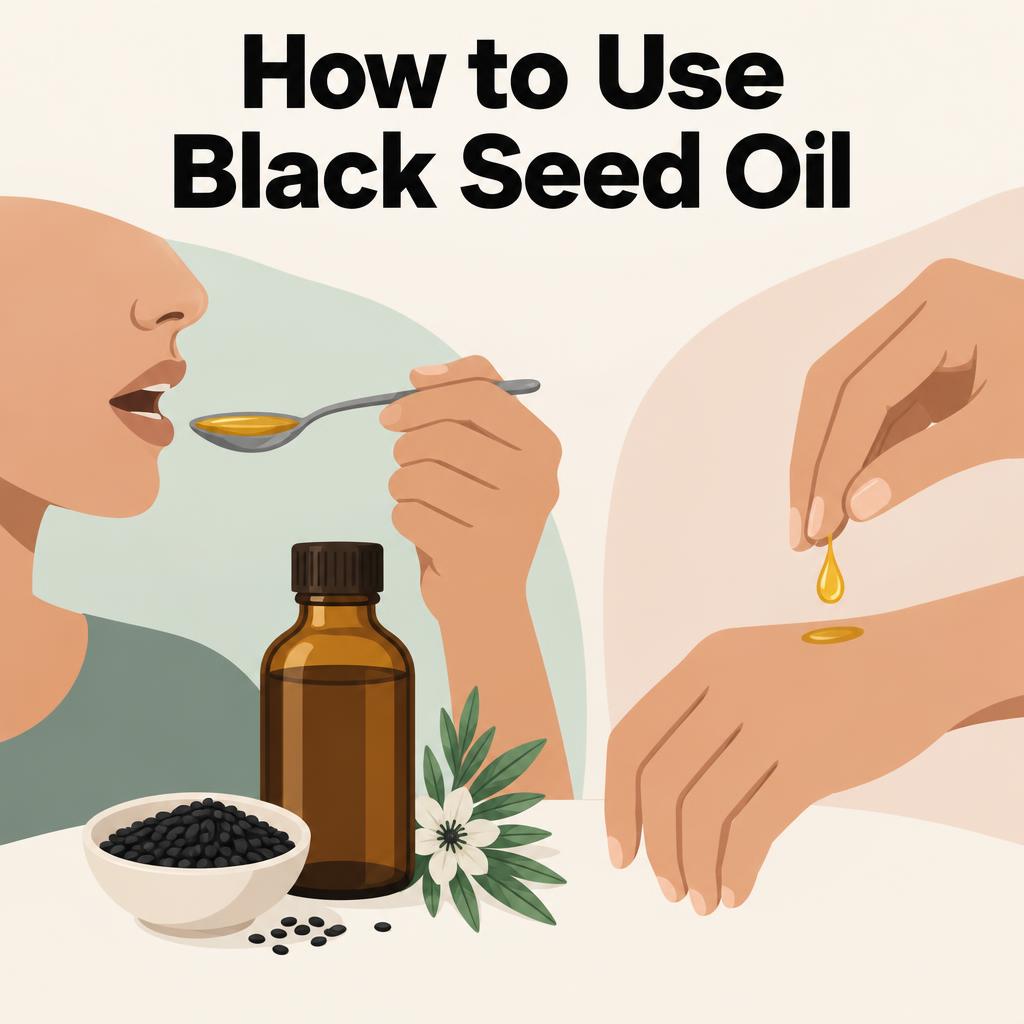
Black seed oil works two ways: taken by mouth for whole-body support, and massaged into skin and hair. Here is how to do both well.
Key takeaways
- Taken internally, one to two teaspoons daily with food supports immune and metabolic health.
- Applied to skin, a few drops can soothe dryness and calm irritation.
- Massaged into the scalp, it is a traditional favourite for hair strength and shine.
- Cold-pressed liquid oil is the versatile format that does both jobs.
The inside job: taking it daily
The most researched use of black seed oil is internal. One to two teaspoons daily with a meal is the amount used across most human trials on immune and metabolic markers. The taste is strong and peppery, so mixing it into honey, juice or a smoothie helps. Consistency over eight to twelve weeks is what the research supports.
The outside job: skin
Black seed oil has been used on skin for centuries, and its thymoquinone content makes it a natural fit. Warm a few drops between your palms and press into clean, slightly damp skin as a final moisturising step. It works well on dry patches, and many people find it calming on easily irritated skin. Patch test on your inner arm first, as with any new oil.
The outside job: hair and scalp
For hair, massage a teaspoon of oil into your scalp, work the remainder through the lengths, and leave it for at least thirty minutes before washing. Once or twice a week is plenty. The tradition behind this use is long, and while human trials on hair growth are limited, the oil's fatty acids and antioxidants make it a sensible, nourishing treatment.
Choosing the right format
One bottle of cold-pressed liquid black seed oil covers every use in this guide: spoonable for internal use, droppable for skin and hair. Softgels are convenient for internal use only. If you want the full inside-and-out routine, the liquid is the format to buy, and a 50 ml bottle with a dropper keeps dosing tidy.
Quality checks that matter
Whatever the use, the oil should be cold-pressed, stored in dark glass and labelled with its Nigella sativa botanical name. A stated thymoquinone content is the best single marker of a serious product. Fresh oil smells peppery and alive; a flat or rancid smell means the bottle is past its best.
The bottom line
Use black seed oil inside and out: one to two teaspoons daily with food for whole-body support, a few drops pressed into skin for moisture and calm, and a weekly scalp massage for hair. A cold-pressed liquid oil with a stated thymoquinone content handles all three jobs from one bottle.
Medical reviewer
Dr Usha Venkataraman
MBBS, FRACGP
Read this next
Black Seed Oil
How to Take Black Seed Oil: A Simple Guide
The simple way to take black seed oil: how much, when, with what, and the small tricks that make the daily habit effortless.
Black Seed Oil
What Does Black Seed Oil Do? A Quick Answer
The short answer: black seed oil supports your immune system, inflammation response and metabolic health. Here is the slightly longer one, with the research.
Black Seed Oil
Is Black Seed Oil Good for You? An Honest Look
An honest, hype-free answer to whether black seed oil is good for you: what the human research supports, where it is thin, and who it suits.
Black Seed Oil
Black Seed Oil: Benefits, Uses and Side Effects (Complete Guide)
Black seed oil has been used for over two thousand years and is now backed by dozens of human trials. Here is the complete picture: benefits, uses and safety.
Black Seed Oil
Black Seed Oil Benefits: 10 Reasons People Take It
From immune support to skin and hair, here are the ten most researched and most loved reasons people take black seed oil every day.
Black Seed Oil
Black Cumin Seed Oil: A Complete Guide
Black cumin seed oil is simply another name for black seed oil, from Nigella sativa. Here is what the name means, what the oil does, and how to use it.
Sources
- Hannan MA, et al. Black cumin (Nigella sativa L.): a comprehensive review on phytochemistry, health benefits, molecular pharmacology, and safety. Nutrients. 2021.
- Tavakkoli A, et al. Review on clinical trials of black seed (Nigella sativa) and its active constituent, thymoquinone. Journal of Pharmacopuncture. 2017.
