United States
How Is Black Seed Oil Made? (And Can You Make It at Home?)
Black seed oil is made by cold-pressing Nigella sativa seeds. Here is how the process works, and why home pressing rarely pays off.
Key takeaways
- Quality black seed oil is cold-pressed from Nigella sativa seeds without heat or solvents.
- Cold pressing protects thymoquinone, the oil's signature active compound.
- Home pressing is possible with an oil press but yields little oil from many seeds.
- A tested, cold-pressed commercial oil is usually the better buy.
It starts with the seed
Black seed oil comes from the small black seeds of Nigella sativa, a flowering plant grown across the Middle East, Africa and South Asia. Seed quality decides oil quality, which is why origin matters. Ethiopian black seed is especially prized, because the growing conditions there produce seeds with naturally high thymoquinone, the oil's signature active compound.
Cold pressing: the gold standard
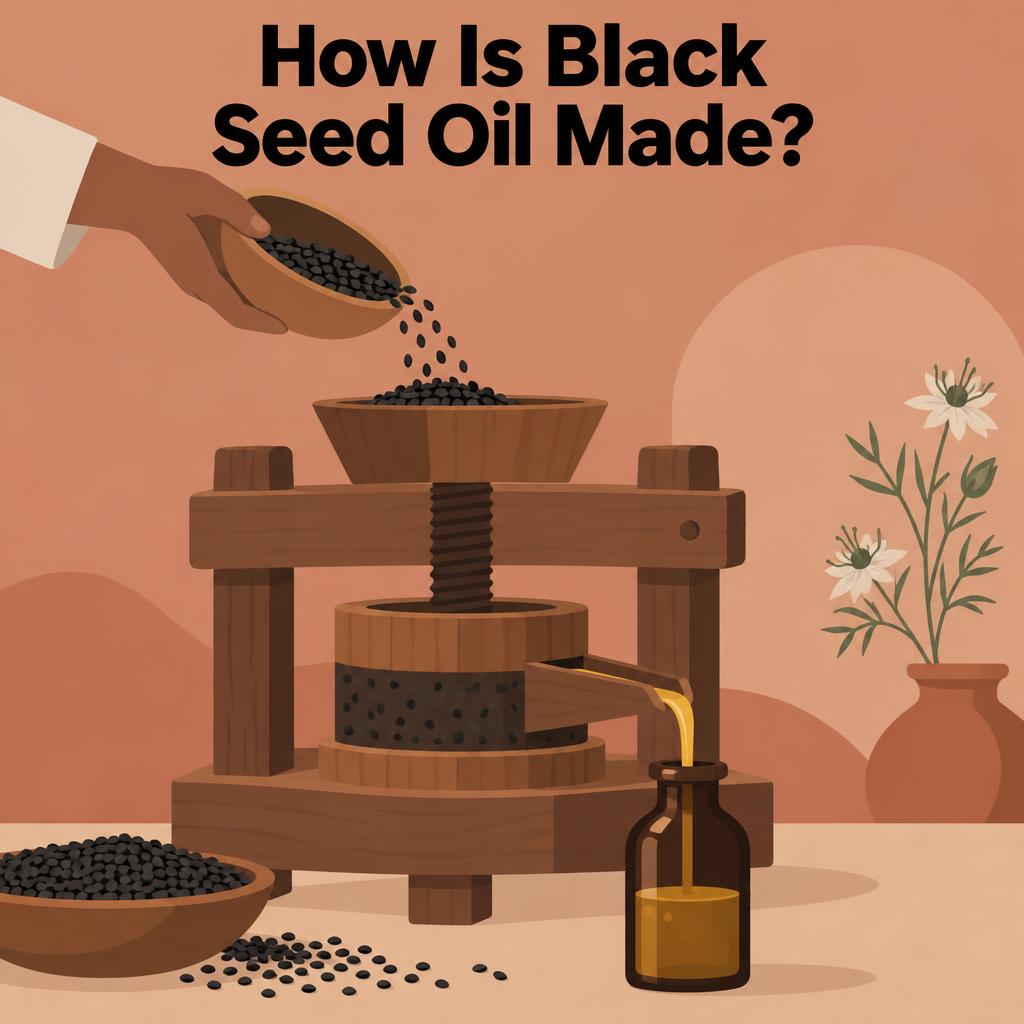
The best black seed oil is made by cold pressing: seeds are cleaned, then mechanically pressed at low temperatures with no chemical solvents. Keeping heat low matters because heat degrades the delicate volatile compounds, including thymoquinone, that the oil is valued for. The result is a dark, peppery, full-strength oil.
Filtering and bottling
After pressing, the oil is filtered to remove seed particles, then bottled promptly in dark glass to protect it from light. Good producers minimise the time between pressing and bottling, because freshness shows in both the taste and the potency. A harvest or pressing date on the label is a sign of a producer who cares.
What to avoid: solvent extraction
Cheaper oils are extracted with chemical solvents and heat, which pull more oil from the seed but strip and damage the active compounds. The label rarely advertises this, so the positive signal to look for is the phrase cold-pressed, backed up by a stated thymoquinone content.
Can you make it at home?
Technically yes, with a home oil press and a large quantity of Nigella sativa seeds. Practically, it is hard to recommend. Seeds contain a modest percentage of oil, so you need a lot of seed for a small bottle, home presses struggle with such small, hard seeds, and you cannot test your thymoquinone content. Most home attempts end as an interesting experiment rather than a supply.
The smarter move
Given the effort and the untestable result, buying a tested cold-pressed oil is the sensible route. Look for Nigella sativa on the label, cold-pressed extraction, dark glass and a published thymoquinone content. That combination tells you the making was done properly, so you can simply enjoy the oil.
The bottom line
Black seed oil is made by cold-pressing Nigella sativa seeds at low temperatures, then filtering and bottling in dark glass. Home pressing is possible but impractical, so buy a cold-pressed oil with a stated thymoquinone content instead.
Medical reviewer
Dr Mackie Abu-Bakr
MBBS, MRCS, MRCGP, FRACGP
Read this next
Black Seed Oil
What Is Black Seed Oil? A Simple Explanation
Black seed oil explained simply: where it comes from, what is in it, what the research says and how people use it every day.
Black Seed Oil
Cold-Pressed Black Seed Oil: Why the Extraction Method Matters
Cold-pressed is more than a marketing phrase for black seed oil. Here is how extraction affects the thymoquinone and quality of the oil you buy.
Black Seed Oil
Ethiopian Black Seed Oil: What Makes It Different?
Ethiopian black seed oil has a reputation as the most potent in the world. Here is why the origin matters and what to look for on the label.
Black Seed Oil
Black Seed Oil: Benefits, Uses and Side Effects (Complete Guide)
Black seed oil has been used for over two thousand years and is now backed by dozens of human trials. Here is the complete picture: benefits, uses and safety.
Black Seed Oil
Black Seed Oil Benefits: 10 Reasons People Take It
From immune support to skin and hair, here are the ten most researched and most loved reasons people take black seed oil every day.
Black Seed Oil
Black Cumin Seed Oil: A Complete Guide
Black cumin seed oil is simply another name for black seed oil, from Nigella sativa. Here is what the name means, what the oil does, and how to use it.
Sources
- Hannan MA, et al. Black cumin (Nigella sativa L.): a comprehensive review on phytochemistry, health benefits, molecular pharmacology, and safety. Nutrients. 2021.
- Tavakkoli A, et al. Review on clinical trials of black seed (Nigella sativa) and its active constituent, thymoquinone. Journal of Pharmacopuncture. 2017.
