United States
How Much Black Seed Oil Should You Take Daily?
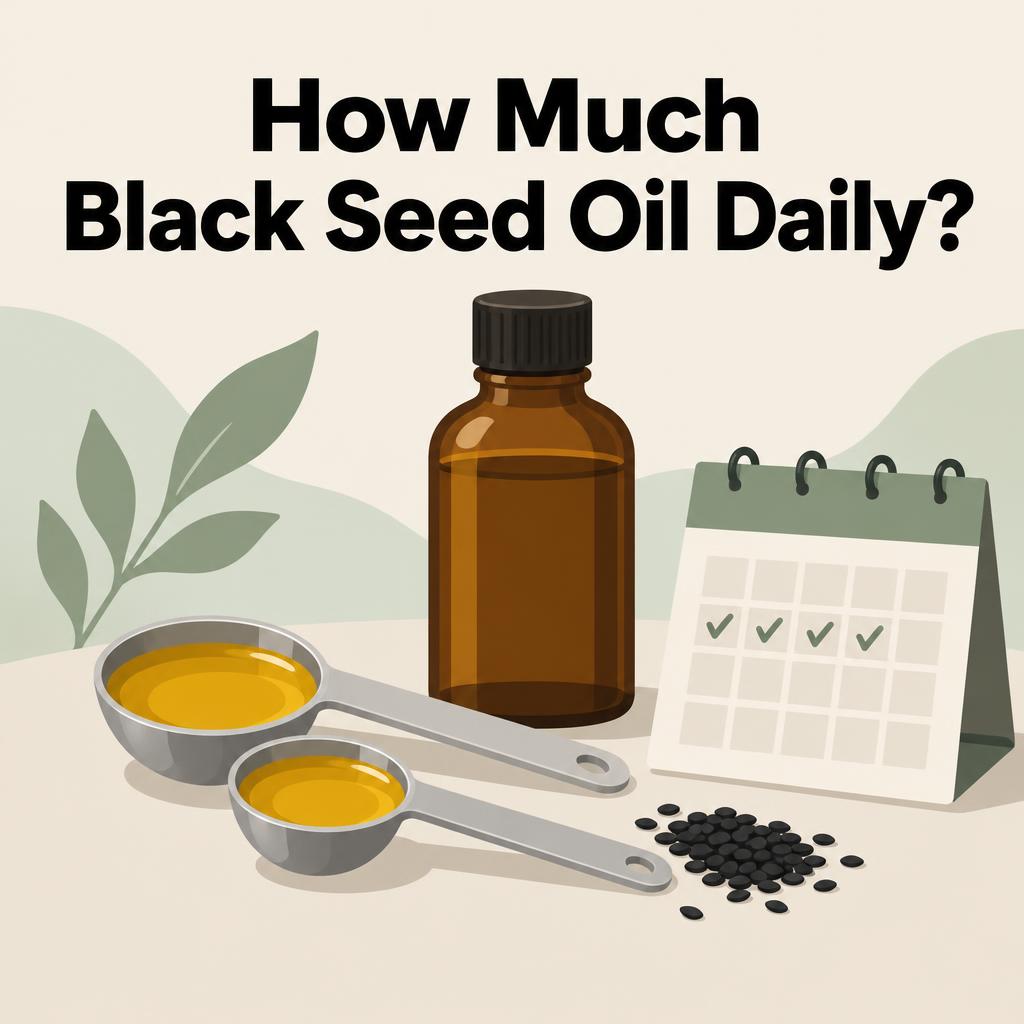
The research-backed daily amount of black seed oil is one to two teaspoons. Here is how that translates to drops, softgels and your routine.
Key takeaways
- Most human trials used one to two teaspoons daily, roughly 2.5 to 5 ml.
- Start with one teaspoon for the first week, then increase if you like.
- In softgels, look for a serving providing around 2,000 to 3,000 mg of black seed oil.
- Taking more than the studied range is not known to work better.
The research-backed range
Across the human trials on black seed oil, the most common daily amount is one to two teaspoons of the liquid oil, about 2.5 to 5 ml. That range showed up in studies on blood sugar, cholesterol, blood pressure and immune markers. It is a food-level amount, which is part of why the safety record is so good.
Starting out
If you are new to black seed oil, begin with one teaspoon daily for the first week. This lets your digestion adjust and lets you get used to the strong, peppery taste. After that, move to two teaspoons if you want the full studied amount. There is no evidence that larger servings work better, so there is no reason to push beyond the studied range.
Converting to softgels
If you prefer softgels, check the supplement facts for the amount of black seed oil per serving. A well-designed serving provides around 2,000 to 3,000 mg, which lands in the same range as the liquid studies. A typical combination product delivers 3,000 mg of black seed oil across three softgels, which maps neatly onto the research.
Splitting the serving
You can take your full daily amount at one meal, or split it between two. Splitting suits people who find a full two teaspoons heavy on the stomach. Either way, take it with food: it improves tolerance and helps your body absorb the oil's fat-soluble compounds.
Signs you have it right
The right amount is the one you can take comfortably every day for months. Mild stomach upset usually means you took it on an empty stomach, not that the amount is wrong. Give the routine eight to twelve weeks at a consistent daily serving before judging results, because that is the timeframe the clinical research used.
The bottom line
Take one to two teaspoons of black seed oil daily with food, or a softgel serving of around 2,000 to 3,000 mg. Start at the lower end for a week, stay consistent for at least eight to twelve weeks, and skip the temptation to megadose: the studied range is where the evidence lives.
Medical reviewer
Dr Hossein Samaei
MD, FRACGP
Read this next
Black Seed Oil
How to Take Black Seed Oil: A Simple Guide
The simple way to take black seed oil: how much, when, with what, and the small tricks that make the daily habit effortless.
Black Seed Oil
Black Seed Oil Capsules vs Liquid: Which Is Better?
Capsules and liquid deliver the same black seed oil, but they suit different people. Here is an honest comparison to help you pick.
Black Seed Oil
What Does Black Seed Oil Do? A Quick Answer
The short answer: black seed oil supports your immune system, inflammation response and metabolic health. Here is the slightly longer one, with the research.

Black Seed Oil
Black Seed Oil: Benefits, Uses and Side Effects (Complete Guide)
Black seed oil has been used for over two thousand years and is now backed by dozens of human trials. Here is the complete picture: benefits, uses and safety.

Black Seed Oil
Black Seed Oil Benefits: 10 Reasons People Take It
From immune support to skin and hair, here are the ten most researched and most loved reasons people take black seed oil every day.
Black Seed Oil
Black Cumin Seed Oil: A Complete Guide
Black cumin seed oil is simply another name for black seed oil, from Nigella sativa. Here is what the name means, what the oil does, and how to use it.
Sources
- Hannan MA, et al. Black cumin (Nigella sativa L.): a comprehensive review on phytochemistry, health benefits, molecular pharmacology, and safety. Nutrients. 2021.
- Tavakkoli A, et al. Review on clinical trials of black seed (Nigella sativa) and its active constituent, thymoquinone. Journal of Pharmacopuncture. 2017.
