Australia
Black Caraway Seed Oil: Is It the Same as Black Seed Oil? An Australian Label Guide
Why botanical names matter when Australian shops use black caraway, black cumin and black seed on different labels.
Key takeaways
- Black caraway is an ambiguous common name, not a guaranteed ingredient identity.
- Nigella sativa identifies the black seed used in the research discussed here.
- Ordinary caraway, Carum carvi, is a different plant.
A bottle labelled black caraway seed oil may be the Nigella sativa oil you are looking for, but the common name is not enough to confirm it. This is a naming question first, not a contest between two proven categories of health supplement.
Australian buyers can encounter imported labels with names drawn from different languages and traditions. A quick ingredient check is more useful than choosing whichever wording sounds familiar.
What does black caraway mean?
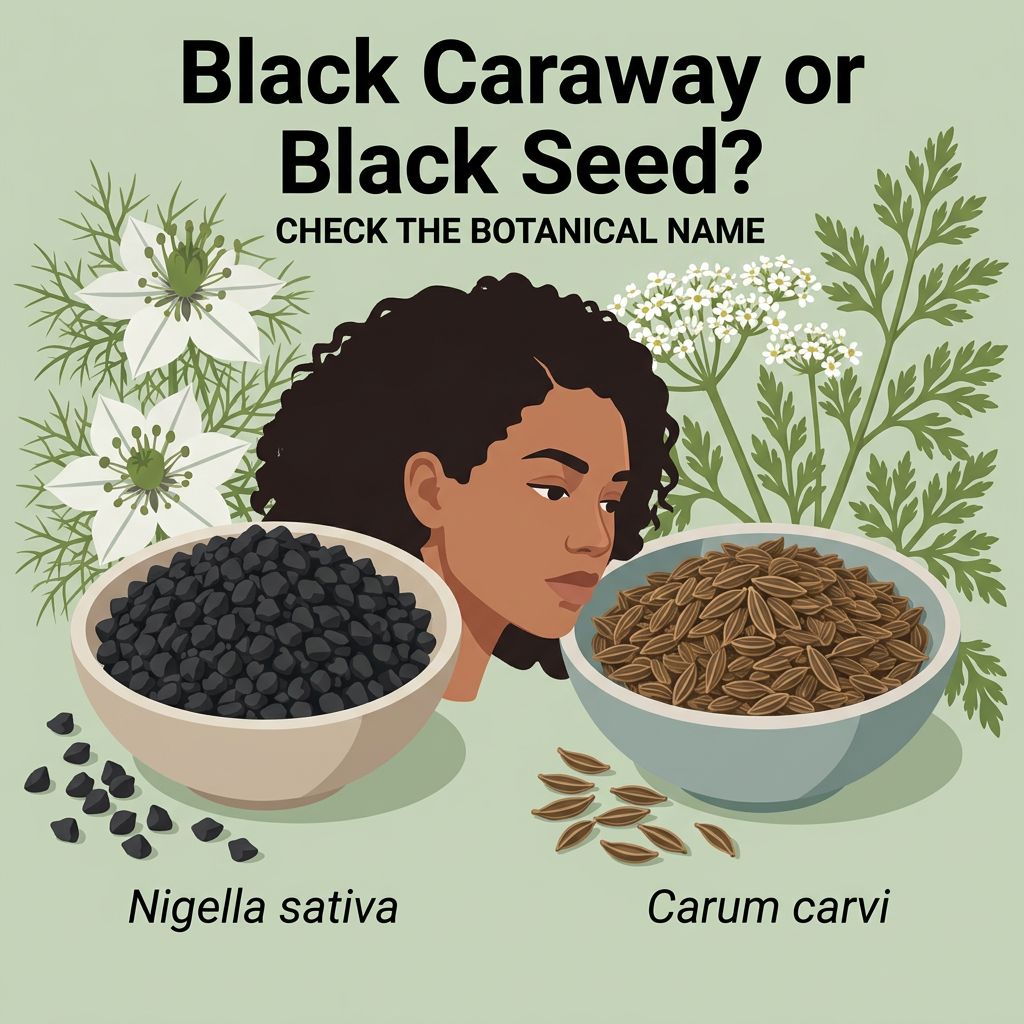
Common names do not follow the precision of scientific names. Black caraway is sometimes used for Nigella sativa, while other seed spices may also be sold under similar names. Do not assume every product using those words contains the same plant.
Nigella sativa is a flowering plant in the buttercup family. Its small black seeds and the oil made from them are the ingredients usually meant by black seed oil in the research cited on this site.[1]
How is ordinary caraway different?
Ordinary caraway is Carum carvi, a separate botanical species. Its elongated brown seeds are familiar in cooking. A label listing Carum carvi is not identifying Nigella sativa, regardless of the colour or style of the packaging.
The distinction matters because evidence for one botanical ingredient should not be transferred to another. Similar names do not establish matching chemical composition, servings or health effects.
A five-step label check
- Find the scientific name in the ingredients or product specification.
- Confirm whether the product is seed oil, seed powder, extract or a blend.
- Check any carrier oils and added botanicals.
- Compare the stated amount per serving, not just the bottle volume.
- Ask the seller for clarification if the botanical name is missing.
A product called pure black caraway oil that does not disclose its species gives you less information than a clearly identified Nigella sativa oil. Marketing language such as premium or ancient does not resolve the identity question.
What does the research apply to?
A 2023 overview of systematic reviews concerned Nigella sativa preparations and a range of health outcomes. It did not establish that every oil sold under every alternative common name produces those outcomes. Much of the evaluated evidence was low or very low quality.[2]
Even when a bottle contains Nigella sativa, compare the formulation to the research. Whole seeds, powders and oils are not automatically equivalent. An ingredient match is a starting point, not a guarantee of benefit.
An Antidote Supplements example
Antidote Supplements' standalone Ethiopian Black Seed Oil is a 50 mL liquid product. The supplied label describes 100% Ethiopian black seed oil with up to 4.64% naturally occurring thymoquinone. It contains no oregano oil.
The separate 240-softgel combination includes oregano oil extract. If your goal is a standalone seed oil, choose the liquid product rather than assuming both formats have identical ingredients. Check the current full label before buying.
Shopping from Australia
Antidote Supplements confirms Australian delivery. Check the checkout for current costs and delivery options; we have not verified local retail stockists. If the product's botanical identification remains unclear, contact the seller before placing an order.
Where an Australian seller makes complementary-medicine claims, consult the TGA's explanation of listed and registered products. A familiar common name does not establish a product's regulatory status.[3]
The bottom line
Black caraway seed oil may mean black seed oil, but only the botanical identification can settle the question. Look for Nigella sativa, then compare the formulation and serving details. Do not substitute ordinary caraway oil based on a similar name.
Medical reviewer
Dr Darren So
FRACGP, DCH, MBBS, BSc, RANZCOG, MYMH
Read this next
Black Seed Oil
Black Seed Oil Benefits: What the Research Says
From skin health to blood sugar, here's what studies on black seed oil actually show.
Nigella sativa
Nigella Sativa: Research Overview of Black Seed
The plant, the compounds and where the evidence is strongest.
Comparisons
Black Seed Oil vs Black Cumin Seed Oil: Are They the Same Thing? Australia Guide
When two different product names identify the same ingredient, compare processing, serving amounts and added oils instead.
Buying Guides
Black Seed Oil in Australia: How to Choose a Good One
Compare purity, batch information, serving size and delivered value when shopping for standalone black seed oil in Australia.
Comparisons
Black Seed Oil Capsules vs Liquid: Which Is Better in Australia?
Compare standalone black seed oil bottles and capsules by serving information, flavour and ingredients, without confusing them with oregano blends.
Buying Guides
Organic Black Seed Oil: Is It Worth Paying More in Australia?
Learn what an organic claim can tell you, how to check certification and when a price premium fits your own buying priorities.
Sources
- Royal Botanic Gardens, Kew. Plants of the World Online: Nigella sativa L. botanical names and classification.
- Li Z, et al. Nigella sativa and health outcomes: An overview of systematic reviews and meta-analyses. Frontiers in Nutrition. 2023;10:1107750.
- Therapeutic Goods Administration. Understanding listed and registered complementary medicine regulation.
