Australia
Black Seed Oil vs Black Cumin Seed Oil: Are They the Same Thing? Australia Guide
When two different product names identify the same ingredient, compare processing, serving amounts and added oils instead.
Key takeaways
- Black seed oil and black cumin seed oil can both refer to Nigella sativa.
- A matching botanical name does not mean two commercial oils are identical.
- Compare like-for-like servings and ingredient lists, not the front-label name.
If two Australian product listings say black seed oil and black cumin seed oil, you may be looking at the same botanical ingredient under different names. That can make shopping feel more complicated than it needs to be.
The useful comparison begins after you identify the plant. This guide explains which differences still matter when the scientific name matches, rather than treating every alternative name as a different supplement.
When are the names interchangeable?
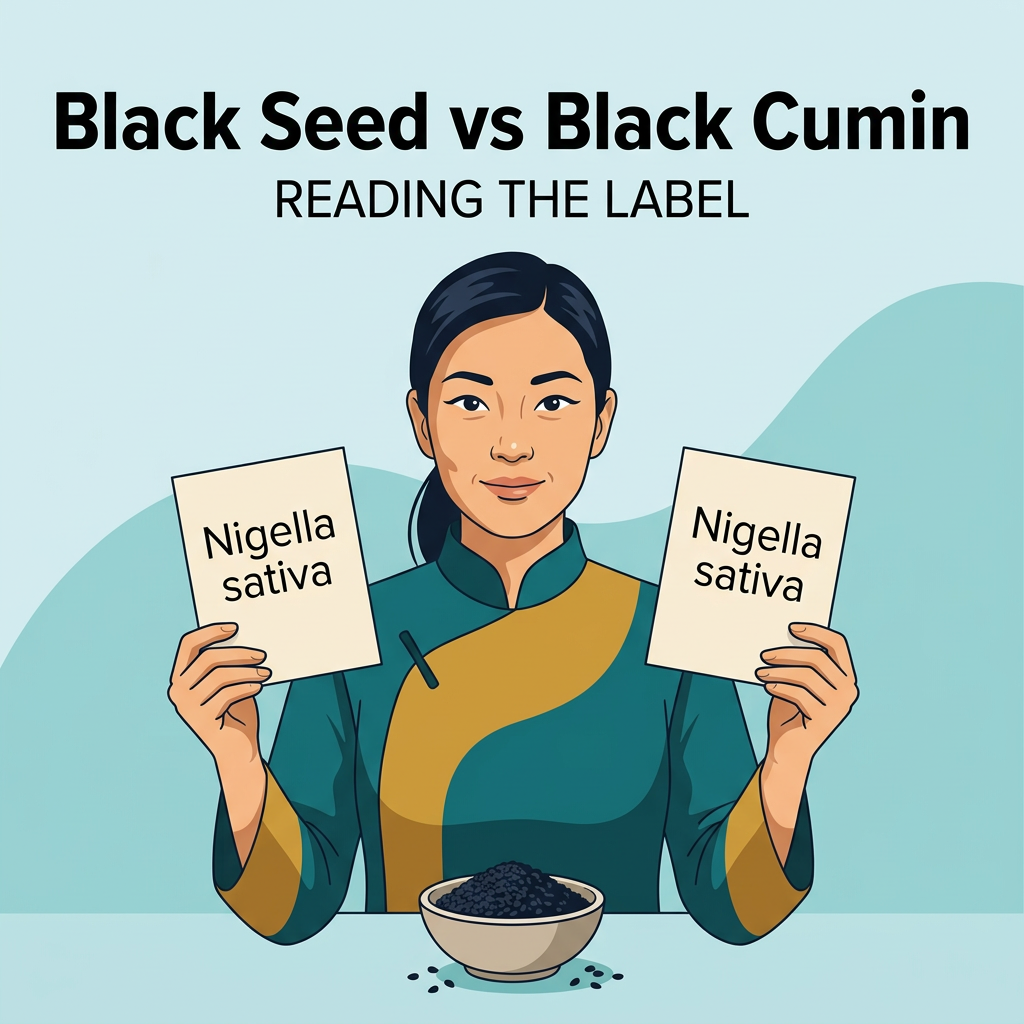
When both products identify Nigella sativa, black seed oil and black cumin seed oil describe oil from the same species. Nigella sativa is distinct from ordinary culinary cumin. Check the scientific name because common names can overlap across plants.[1]
Do not assume an unlabeled bottle of cumin oil is Nigella sativa. If the ingredients identify a different species or do not identify one at all, ask the seller before treating the products as substitutes.
Same species, different product
Two Nigella sativa oils may differ in origin, extraction method, storage, freshness, other ingredients and the amount supplied per serving. Those differences do not create a new species, but they can change how you use and compare the products.
Cold-pressed is a processing description, not proof that an oil has better clinical effects. Ethiopian describes origin, not an independently established health ranking. Use these details alongside a complete label, rather than as shortcuts for quality.
Compare the amount you actually take
For liquids, note the serving in millilitres and the bottle volume. For capsules, check how many capsules make one serving and how much black seed oil that serving contains. Do not compare one teaspoon to one capsule without those quantities.
A blend may contain less black seed oil than its total oil amount suggests. A softgel may also contain oregano extract, which makes it a different formulation from a standalone Nigella sativa liquid.
What does a thymoquinone percentage tell you?
Thymoquinone is a naturally occurring compound associated with Nigella sativa. A disclosed percentage can provide composition information, but testing methods and batches matter. An up-to figure is an upper limit, not a promise that every serving has precisely that concentration.
A higher thymoquinone percentage has not been established as a universal route to better outcomes. Research has used different preparations, and a 2023 overview found substantial uncertainty in much of the human evidence.[2]
Comparing Antidote Supplements' two formats
The standalone Ethiopian Black Seed Oil comes in a 50 mL liquid bottle. The combination product comes in a 240-softgel pouch. Its three-softgel serving supplies 3,000 mg black seed oil and 100 mg oregano oil extract.
For someone choosing between names for a pure seed oil, the standalone liquid is the relevant comparison. For someone seeking both ingredients, the combination softgels answer a different buying question. Neither format should be renamed to make it look equivalent to the other.
An Australian consumer checklist
- Confirm Nigella sativa before comparing brands.
- Compare single-ingredient products with single-ingredient products.
- Read current directions and any allergy information.
- Check the seller's registration claims against TGA guidance when applicable.
- Use the checkout to confirm delivery costs rather than assuming a local advertised price.
Antidote Supplements confirms delivery to Australia. This is an owner-confirmed availability statement, not a claim of Australian medicine registration. The TGA explains how listed and registered complementary medicines differ.[3]
The bottom line
Black seed oil and black cumin seed oil often mean the same species, Nigella sativa. Once that is confirmed, focus on the formulation, serving size and transparent labelling. A different common name alone is not a reason to pay more or expect a different benefit.
Medical reviewer
Dr Akhter Hossain
MBBS, FRACGP
Read this next
Black Seed Oil
Black Seed Oil Benefits: What the Research Says
From skin health to blood sugar, here's what studies on black seed oil actually show.
Nigella sativa
Nigella Sativa: Research Overview of Black Seed
The plant, the compounds and where the evidence is strongest.
Comparisons
Black Caraway Seed Oil: Is It the Same as Black Seed Oil? An Australian Label Guide
Why botanical names matter when Australian shops use black caraway, black cumin and black seed on different labels.
Buying Guides
Black Seed Oil in Australia: How to Choose a Good One
Compare purity, batch information, serving size and delivered value when shopping for standalone black seed oil in Australia.
Comparisons
Black Seed Oil Capsules vs Liquid: Which Is Better in Australia?
Compare standalone black seed oil bottles and capsules by serving information, flavour and ingredients, without confusing them with oregano blends.
Buying Guides
Organic Black Seed Oil: Is It Worth Paying More in Australia?
Learn what an organic claim can tell you, how to check certification and when a price premium fits your own buying priorities.
Sources
- Royal Botanic Gardens, Kew. Plants of the World Online: Nigella sativa L. botanical names and classification.
- Li Z, et al. Nigella sativa and health outcomes: An overview of systematic reviews and meta-analyses. Frontiers in Nutrition. 2023;10:1107750.
- Therapeutic Goods Administration. Understanding listed and registered complementary medicine regulation.
