United States
How to Consume Black Seed Oil: Spoon, Capsule or in Food?
Straight off the spoon, blended into food, or swallowed as a softgel: every way to consume black seed oil, with the pros and cons of each.
Key takeaways
- The classic method is one to two teaspoons of liquid oil daily with a meal.
- Mixing into honey, juice, smoothies or dressings solves the peppery taste.
- Softgels deliver the same oil with no taste and an exact dose.
- Never cook with black seed oil over high heat; add it to food after cooking.
Method one: straight off the spoon
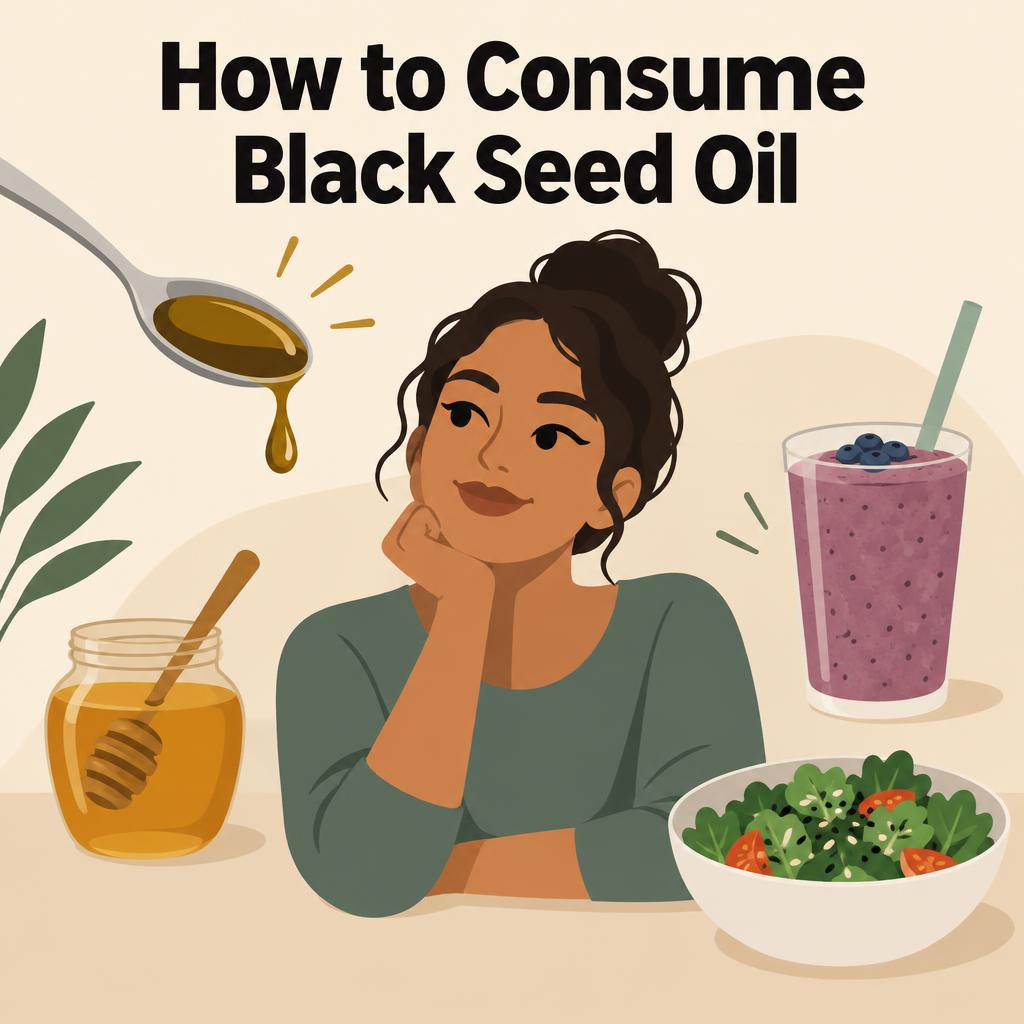
The traditional method is the simplest: measure one to two teaspoons and swallow, followed by a sip of water or juice. It is fast, exact and needs nothing else. The catch is the taste, which is strong, peppery and bitter. People who tolerate it love the simplicity; people who do not should read on, because there are easy fixes.
Method two: mixed into food and drink
The classic fix is a spoonful of raw honey, a traditional pairing that tames the bitterness beautifully. Black seed oil also blends well into smoothies, fresh juice, yoghurt and salad dressings. One rule matters here: add the oil after cooking, never during. High heat degrades the delicate compounds, including thymoquinone, that you are taking it for.
Method three: softgels
Softgels are the taste-free, travel-friendly option. Each serving delivers an exact, pre-measured amount of oil, which removes guesswork entirely. A well-designed serving provides around 2,000 to 3,000 mg, matching the range used in human trials. If the liquid's taste has ever broken your habit, softgels are the answer.
Which method is best?
Nutritionally, all three deliver the same oil, so the best method is the one you will stick with daily. Liquid gives you flexibility, including topical use on skin and hair from the same bottle. Softgels give you convenience and consistency. Many people keep both: liquid at home, softgels for work and travel.
How much, and when
Whichever method you choose, the studied amount is one to two teaspoons daily, or the softgel equivalent, taken with food. Start at the lower end for your first week. Morning or night makes no proven difference; consistency over eight to twelve weeks is what the research supports.
Quality before method
No consumption method can rescue a poor oil. Look for the botanical name Nigella sativa on the label, cold-pressed extraction, dark glass packaging and a stated thymoquinone content. Ethiopian-origin oils are prized for naturally high thymoquinone. Get the bottle right first, then pick the method that suits your life.
The bottom line
Consume black seed oil straight off the spoon, mixed into honey, juice or dressings, or as softgels; all deliver the same oil. Take one to two teaspoons daily with food, add it to dishes only after cooking, and choose the method you can keep up every day.
Medical reviewer
Dr Akhter Hossain
MBBS, FRACGP
Read this next
Black Seed Oil
How to Take Black Seed Oil: A Simple Guide
The simple way to take black seed oil: how much, when, with what, and the small tricks that make the daily habit effortless.
Black Seed Oil
Black Seed Oil Capsules vs Liquid: Which Is Better?
Capsules and liquid deliver the same black seed oil, but they suit different people. Here is an honest comparison to help you pick.
Dosage & Timing
When to Take Black Seed Oil: Morning or Night?
Morning or night? The honest answer is that consistency matters more than timing. Here is how to pick the slot you will actually keep.
Black Seed Oil
Black Seed Oil: Benefits, Uses and Side Effects (Complete Guide)
Black seed oil has been used for over two thousand years and is now backed by dozens of human trials. Here is the complete picture: benefits, uses and safety.

Black Seed Oil
Black Seed Oil Benefits: 10 Reasons People Take It
From immune support to skin and hair, here are the ten most researched and most loved reasons people take black seed oil every day.
Black Seed Oil
Black Cumin Seed Oil: A Complete Guide
Black cumin seed oil is simply another name for black seed oil, from Nigella sativa. Here is what the name means, what the oil does, and how to use it.
Sources
- Hannan MA, et al. Black cumin (Nigella sativa L.): a comprehensive review on phytochemistry, health benefits, molecular pharmacology, and safety. Nutrients. 2021.
- Tavakkoli A, et al. Review on clinical trials of black seed (Nigella sativa) and its active constituent, thymoquinone. Journal of Pharmacopuncture. 2017.
